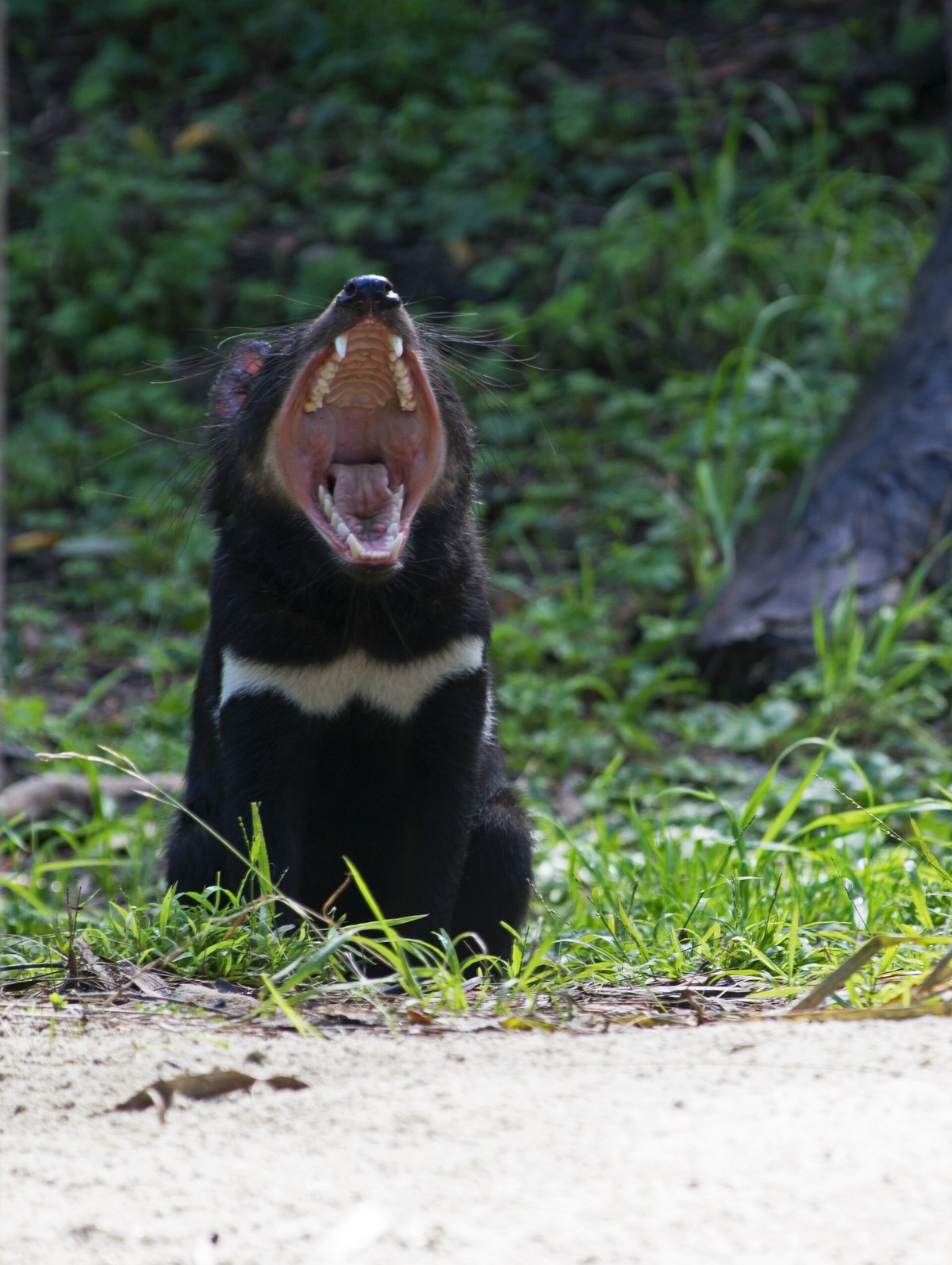
Tasmanian Devil Night Walk — Maria Island Australia
The Maria Island National Park's Tasmanian devil (Sarcophilus harrisii) population — introduced as an insurance colony free from Devil Facial Tumour Disease, now 100+ individuals on a predator-free island — has become the world's most accessible wild Tasmanian devil population. Night guided walks from Darlington produce multiple devil encounters on 95% of departures, the animals' red ear colouration (blood-flushed when excited), their bone-crunching jaw strength (the highest bite force relative to body size of any living mammal), and the extraordinary chuffing 'sneeze' communication calls creating an encounter of considerable sensory intensity. At feeding sites where wallaby carcasses are provided, 3–5 devils feeding simultaneously demonstrate the social hierarchy that governs Tasmanian devil aggregations — the largest animal dominant, the others waiting in a respectful semicircle that breaks down with increasing hunger into the chaos of competitive feeding that gave the species its name.
About this spectacle
On a small predator-free island off Tasmania's east coast, Tasmanian devils — relocated here as an insurance colony safe from Devil Facial Tumour Disease — have thrived to 100-plus individuals, making Maria Island the planet's most accessible place to observe wild devils. Expert-led night walks from the historic Darlington settlement deliver sightings on 95% of departures. At feeding sites, visitors watch 3–5 animals converge on wallaby carcasses under torchlight: the dominant individual commandeers the meal while subordinates hover in a tense semicircle that collapses into anarchic, shrieking competition. The displays are viscerally impressive — the bone-splintering crunch of jaws, the glow of blood-flushed red ears signalling excitement, and the extraordinary chuffing sneeze-call that carries through the dark bush. Up close, the animals are stocky and surprisingly fast, their fur coarse and black, their eyes catching the lamplight. The soundscape — crunching, shrieking, snuffling — is as memorable as anything visual, and the regularity of encounters makes this one of the most reliably dramatic wildlife experiences in Australia.
When to go
Jan — Dec
Getting there
Nearest airport: LST. Nearest city: Hobart.
Booking options
Goyova doesn't process bookings directly. When you tap "Plan this trip" in the app, you'll see options from our partner providers — accommodation, tours, transport — with affiliate links where applicable. See our affiliate disclosure for details.
More like this.
 Peak season
 Aardvark Night Foraging — Kalahari Botswana
Maun, Central District, BW
 Peak season
 Aardvark Night Foraging — Kalahari South Africa
Upington, Northern Cape, South Africa
 Returns Jan 2027
 Adélie Penguin Highway — Ross Sea Antarctica
Cape Royds, Antarctica, AQ