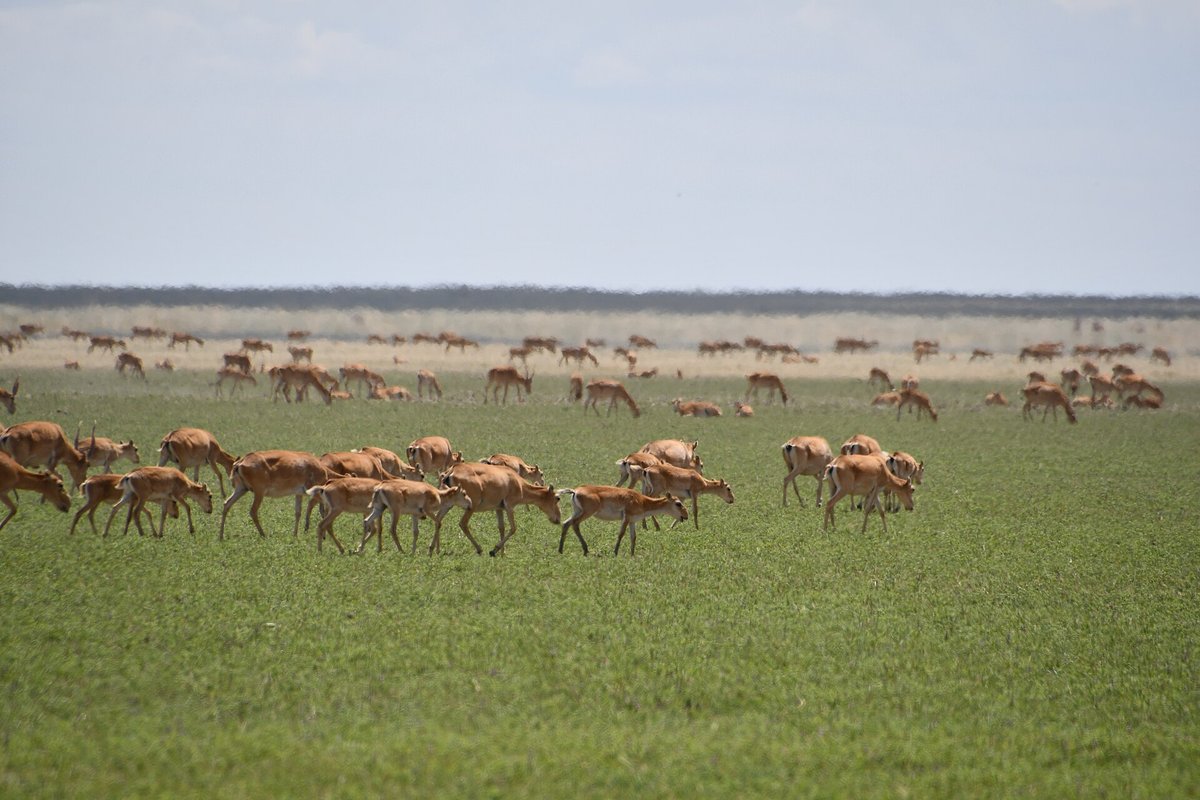
Saiga Antelope Migration — Kalmykia Russia
The saiga antelope (Saiga tatarica) spring migration across the Kalmyk steppe of southern Russia — the steppe republic's 100,000+ saiga moving northward from their Caspian Sea wintering grounds to the calving areas around the Manych depression from March through April, the herds visible from the Elista–Astrakhan highway as a grey-brown mass moving across the red-brown steppe — creates Europe's only mass ungulate migration spectacle. The saiga's extraordinary nose (a proboscis-like inflatable structure that warms and filters the dry steppe air) and the calving aggregation's synchrony (80% of all calves born within 5 days) create the biological backdrop for a migration of considerable ecological and evolutionary significance. The Kalmyk people's traditional Buddhist relationship with the saiga (the animal features in the Kalmyk national identity and shamanic tradition) and the republic's recent creation of a saiga sanctuary give the migration encounter a cultural depth unique in European wildlife.
About this spectacle
Each spring, over 100,000 saiga antelope stream northward across the rust-red Kalmyk steppe, one of the most dramatic yet least-known wildlife migrations in the world. From roadside vantage points along the Elista–Astrakhan highway, visitors watch an undulating grey-brown mass pour across the open plain — hooves raising dust, the herds moving with a fluid, purposeful urgency. The saiga's distinctive bulbous nose, a biological marvel for warming and filtering arid steppe air, gives individual animals an almost prehistoric appearance up close. By late April the migration converges on calving grounds near the Manych depression, where the near-synchronous birth of tens of thousands of calves within days of each other creates a nursery of extraordinary biological intensity. Mornings offer the best light and the most active movement, with herds silhouetted against wide, treeless horizons. The setting is vast and austere — wind-scoured flatlands under enormous skies — and the sense of witnessing something genuinely ancient and fragile, a herd animal hovering between recovery and extinction, lends the spectacle an emotional weight few European wildlife encounters can match.
When to go
Mar — Oct, peak Mar — Apr
Getting there
Nearest airport: ESL. Nearest city: Elista.
Booking options
Goyova doesn't process bookings directly. When you tap "Plan this trip" in the app, you'll see options from our partner providers — accommodation, tours, transport — with affiliate links where applicable. See our affiliate disclosure for details.
More like this.
 Peak season
 Aardvark Night Foraging — Kalahari Botswana
Maun, Central District, BW
 Peak season
 Aardvark Night Foraging — Kalahari South Africa
Upington, Northern Cape, South Africa
 Returns Jan 2027
 Adélie Penguin Highway — Ross Sea Antarctica
Cape Royds, Antarctica, AQ