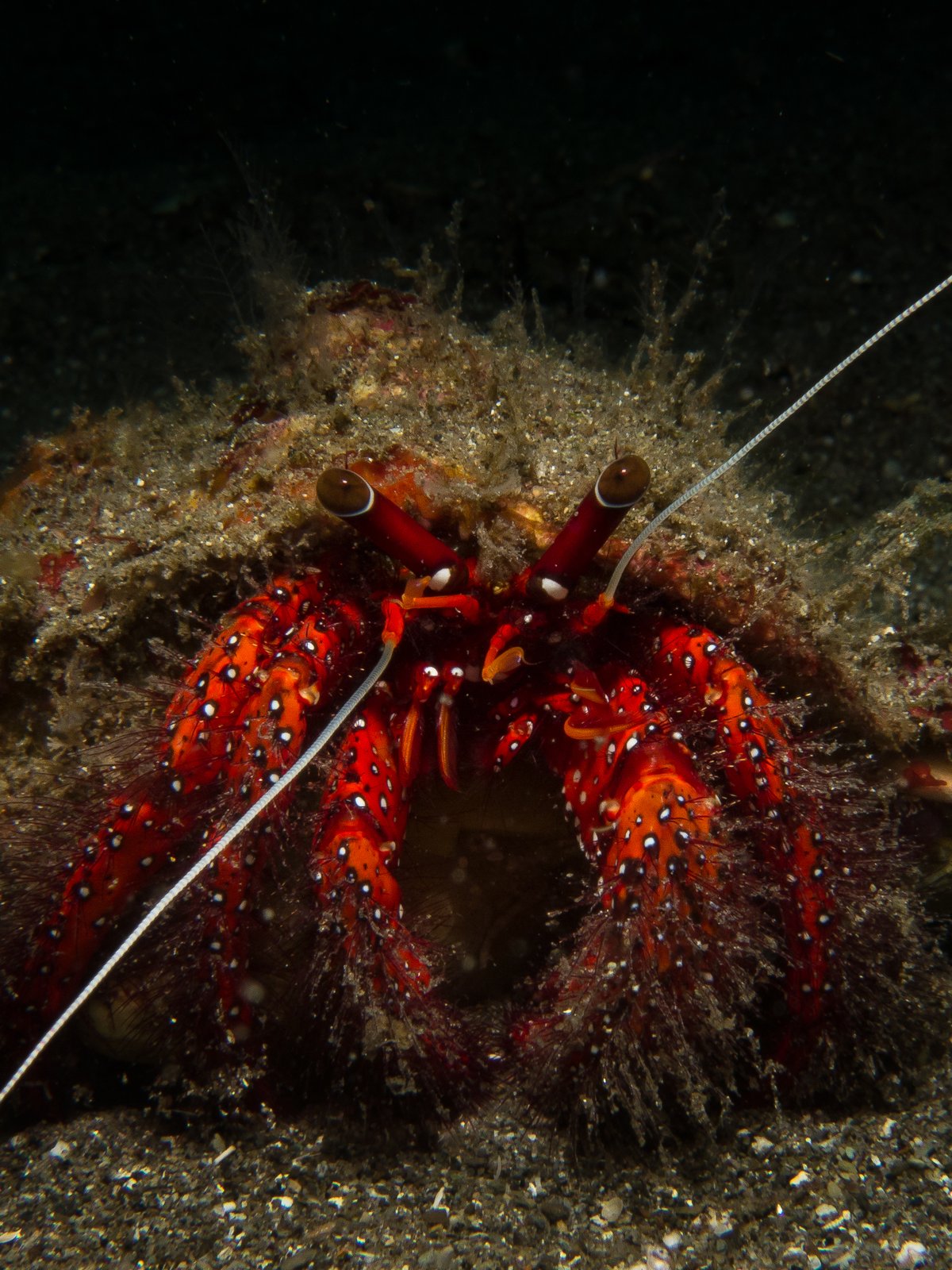
Hermit Crab Shell Exchange — Okinawa Japan
The hermit crab (Coenobita clypeatus and related species) shell exchange behaviour observable in the intertidal rock pools of Okinawa's Iriomote Island — when a new empty shell is placed near a hermit crab aggregation, a chain of simultaneous shell exchanges takes place (the largest crab moves into the new shell, the next largest takes the vacated shell, and so on in a sequential cascade) — creates one of the intertidal world's most remarkable cooperative animal behaviour encounters. The shell exchange cascade (documented to involve up to 20 animals in sequence) requires each crab to assess and await the arrival of the next crab before making its move, creating what researchers have described as a 'vacancy chain' system of extraordinary coordination. The Iriomote National Park's mangrove and reef ecosystem, combined with the Iriomote cat (Prionailurus bengalensis iriomotensis, one of the world's rarest cats) and the blue-tailed bee-eater colonies, makes Iriomote Japan's most ecologically rich subtropical island.
About this spectacle
At Iriomote Island's intertidal rock pools, low tide reveals aggregations of hermit crabs — members of the Coenobita genus — clustered around shoreline boulders and coral rubble. When an empty shell appears nearby, something extraordinary begins: the largest crab in the group moves into it, vacating its own shell for the next in line, which then vacates theirs, and so on in a rippling cascade that can involve up to 20 animals acting in swift, coordinated sequence. Observers crouch at pool level and watch each crab carefully inspect, rotate, and assess the vacated shell before committing — the hesitation and decision-making is visible and almost tangible. The exchange happens quickly once triggered, a blur of scuttling legs and shell-swapping that rewards patience. Morning light catches the wet rock and the polished shell surfaces. The surrounding habitat — fringing mangroves, reef-flat shallows, and subtropical forest — amplifies the sense of discovery. This is a rare example of observable animal coordination at human scale, quiet enough to hear the water draining between rocks.
When to go
Mar — Nov, peak Apr — Oct
Getting there
Nearest airport: ISG. Nearest city: Ishigaki.
Booking options
Goyova doesn't process bookings directly. When you tap "Plan this trip" in the app, you'll see options from our partner providers — accommodation, tours, transport — with affiliate links where applicable. See our affiliate disclosure for details.
More like this.
 Peak season
 Aardvark Night Foraging — Kalahari Botswana
Maun, Central District, BW
 Peak season
 Aardvark Night Foraging — Kalahari South Africa
Upington, Northern Cape, South Africa
 Returns Jan 2027
 Adélie Penguin Highway — Ross Sea Antarctica
Cape Royds, Antarctica, AQ