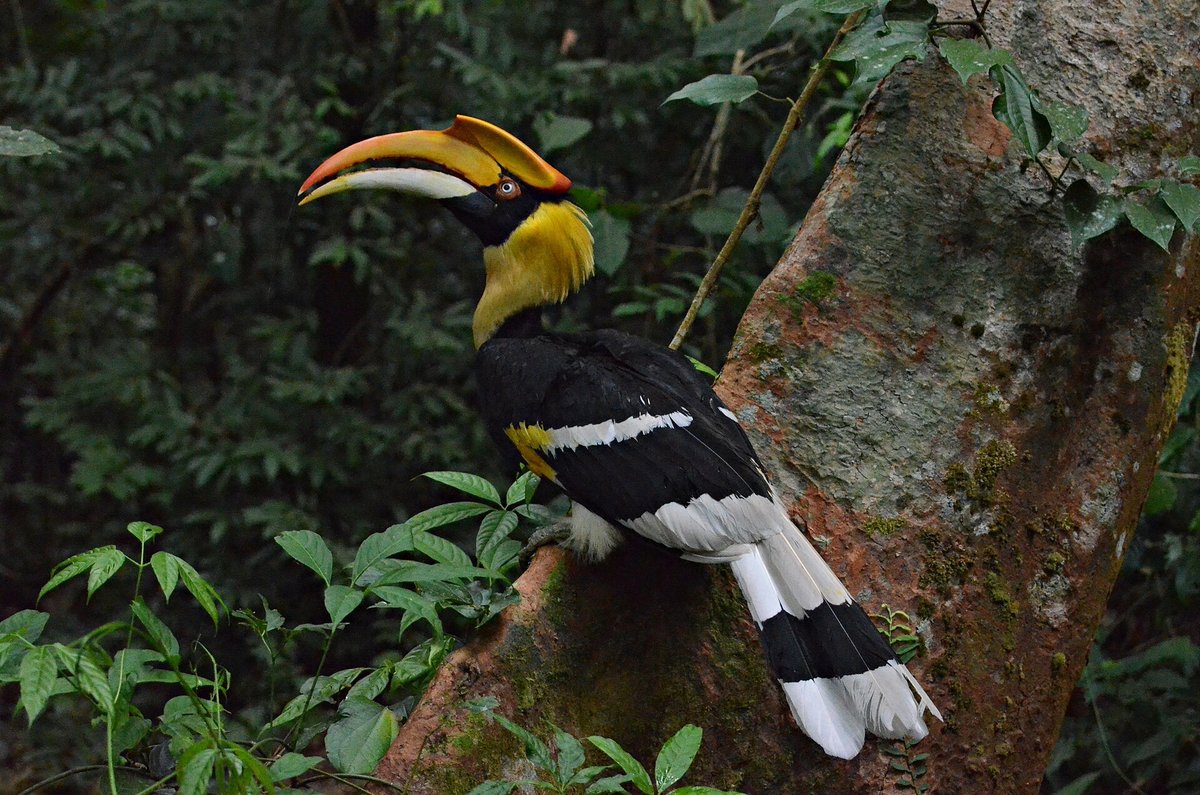
Great Hornbill Season — Khao Yai Thailand
The great hornbill (Buceros bicornis) in the Khao Yai National Park — the largest of the 57 hornbill species, the male's enormous yellow-and-black casque (hollow, used as a resonator for the loud 'kok-kok' call audible 1 kilometre through the forest) and 1.5-metre wingspan creating one of Asia's most visually dramatic large birds observable from the forest road. The Khao Yai's great hornbill population uses the fig trees along the park road as food sources, and the pairs' cooperative nest sealing behaviour (the female sealing herself inside a tree cavity with mud and droppings, with only a slit for the male to pass food for the 40-day incubation and chick-rearing) visible at active nest trees creates a hornbill biology encounter of great specificity. The Khao Yai's combination of its elephant herds, gaur, sambar deer, and 400 bird species creates Thailand's finest UNESCO-listed forest wildlife destination with the great hornbill as its most charismatic resident.
About this spectacle
Standing at the forest road edge at dawn in Khao Yai National Park, visitors hear the great hornbill before seeing it — the resonant 'kok-kok' call carrying a full kilometre through the dense canopy. When the bird arrives at a fig tree, the spectacle is immediate: a 1.5-metre wingspan dark against the morning light, the male's massive yellow-and-black casque catching the sun as it lands heavily on a fruiting branch. Pairs work the trees together, and at active nest cavities, patient watchers can observe the extraordinary sealed nest — only a narrow slit visible in the bark where the enclosed female receives food from her mate. The forest road setting makes sightings accessible without trekking; the hornbills are reliably present around known fig trees and nest sites. The surrounding forest also delivers elephant herds crossing the road, gaur browsing at clearings, and sambar deer at dusk, making every dawn drive a layered wildlife encounter with the great hornbill as the centrepiece.
When to go
Jan — Dec, peak Jan — May
Getting there
Nearest airport: BKK. Nearest city: Nakhon Ratchasima.
Booking options
Goyova doesn't process bookings directly. When you tap "Plan this trip" in the app, you'll see options from our partner providers — accommodation, tours, transport — with affiliate links where applicable. See our affiliate disclosure for details.
More like this.
 Peak season
 Aardvark Night Foraging — Kalahari Botswana
Maun, Central District, BW
 Peak season
 Aardvark Night Foraging — Kalahari South Africa
Upington, Northern Cape, South Africa
 Returns Jan 2027
 Adélie Penguin Highway — Ross Sea Antarctica
Cape Royds, Antarctica, AQ