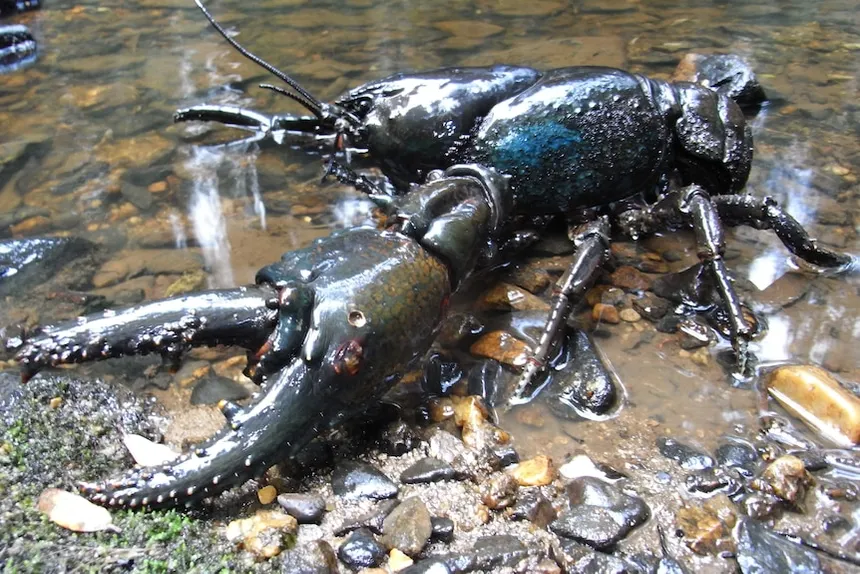
Giant Freshwater Crayfish Habitat — Tasmanian North Coast Rivers
The world's largest freshwater invertebrate — Tasmania's giant freshwater crayfish, reaching over 6 kg — inhabits deep, cold pools of the island's north coast rivers, emerging at night to forage with claws large enough to grip an adult's calf. Snorkelling at dusk in approved rivers offers a face-to-face encounter with a living prehistoric giant.
About this spectacle
Beneath the cold, tannin-stained waters of Tasmania's north coast rivers lives Astacopsis gouldi — the world's largest freshwater invertebrate, capable of exceeding 6 kg and carrying claws broad enough to grip an adult's calf. During daylight these animals retreat to deep pools beneath undercut banks and submerged logs; at dusk they emerge to forage along the riverbed, and approved snorkelling encounters bring you nose-to-face with a creature that looks unchanged by geological time. The rivers run clear but dark, edged by cool temperate rainforest, and in the fading light you may spot the animal's eye-shine before the great armoured body comes into view. The experience is one of pure stillness broken only by cold current and the slow, deliberate movement of a giant. Numbers are low and sightings are far from guaranteed, but seeing one is genuinely unforgettable — a close encounter with an animal that seems to belong to another era.
When to go
Oct — Apr, peak Nov — Mar
Getting there
Nearest airport: LST. Nearest city: Devonport.
Booking options
Goyova doesn't process bookings directly. When you tap "Plan this trip" in the app, you'll see options from our partner providers — accommodation, tours, transport — with affiliate links where applicable. See our affiliate disclosure for details.
More like this.
 Peak season
 Aardvark Night Foraging — Kalahari Botswana
Maun, Central District, BW
 Peak season
 Aardvark Night Foraging — Kalahari South Africa
Upington, Northern Cape, South Africa
 Returns Jan 2027
 Adélie Penguin Highway — Ross Sea Antarctica
Cape Royds, Antarctica, AQ