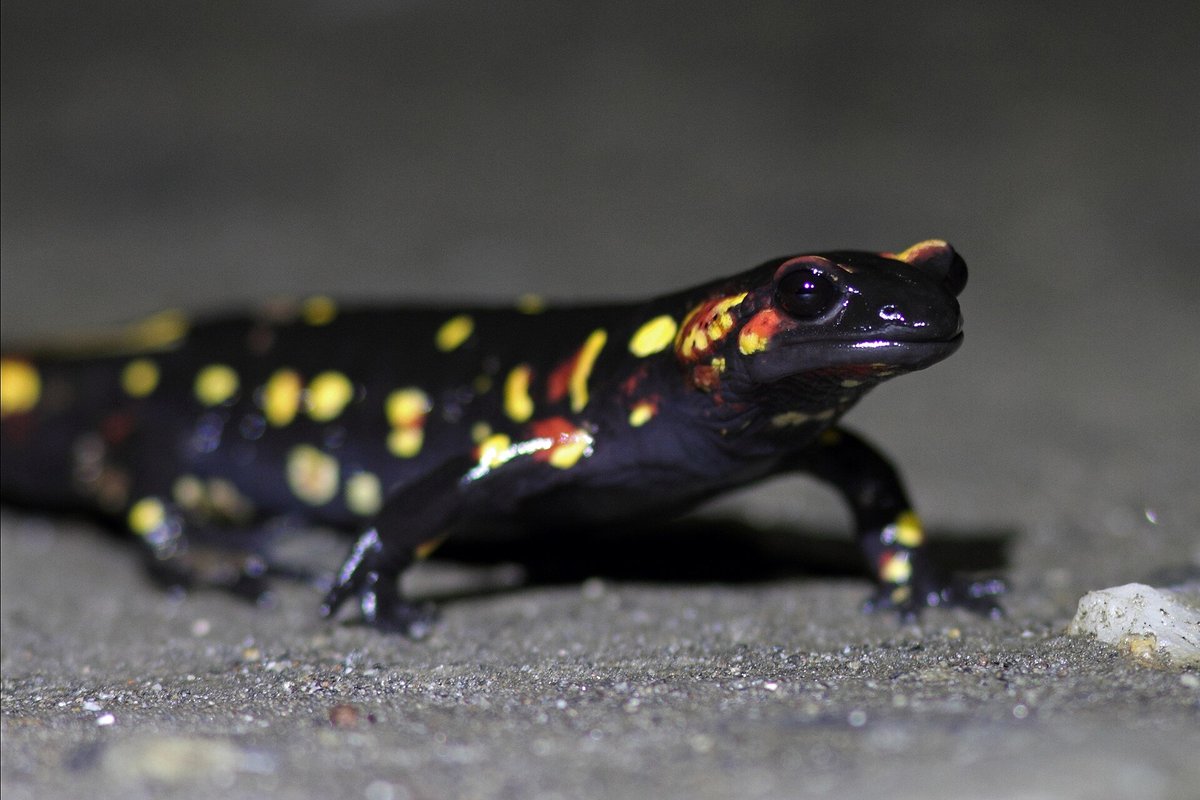
Fire Salamander Night Migration — Belgian Ardennes
The fire salamander (Salamandra salamandra) of the Ardennes forests migrates to breeding streams on warm wet autumn nights from August through October — the brilliant yellow-and-black patterning (aposematic colouration warning of toxic skin secretions) making them visible in torchlight as vivid moving jewels on the forest floor. In the Hertogenwald and Hautes Fagnes reserve of eastern Belgium, fire salamander densities are among the highest in western Europe, and on ideal migration nights (10°C+, rain, no wind) dozens of individuals can be encountered along a 2-kilometre forest track. The salamanders' unhurried, deliberate movement — they walk rather than run, confident in their toxicity — allows extended close observation, and the combination of the rain-soaked Ardennes beech forest, the wet leaf litter catching the torchlight, and the yellow-and-black jewels moving across the beam creates one of central Europe's most distinctive autumn nocturnal wildlife experiences.
About this spectacle
On warm, rain-soaked autumn nights between August and October, the forest tracks of the Hautes Fagnes and Hertogenwald in eastern Belgium come alive with one of Europe's most striking amphibian spectacles. Fire salamanders — boldly patterned in vivid yellow and black — emerge from the beech forest understorey and make their unhurried way to breeding streams, utterly unafraid in the knowledge of their own toxicity. Sweep a torch across the wet leaf litter and the salamanders glow like living enamel against the dark forest floor. In this reserve, densities are among the highest in western Europe; on ideal nights — temperatures above 10°C, steady rain, still air — dozens of individuals can be found along a single 2-kilometre track. Their slow, deliberate walk invites extended, unhurried observation. The surrounding beech forest, dripping and fragrant, amplifies the atmosphere. No binoculars or specialist equipment needed — just a torch, waterproof clothing, and the willingness to walk slowly in the dark.
When to go
Aug — Oct
Getting there
Nearest airport: LGG. Nearest city: Liège.
Booking options
Goyova doesn't process bookings directly. When you tap "Plan this trip" in the app, you'll see options from our partner providers — accommodation, tours, transport — with affiliate links where applicable. See our affiliate disclosure for details.
More like this.
 Peak season
 Aardvark Night Foraging — Kalahari Botswana
Maun, Central District, BW
 Peak season
 Aardvark Night Foraging — Kalahari South Africa
Upington, Northern Cape, South Africa
 Returns Jan 2027
 Adélie Penguin Highway — Ross Sea Antarctica
Cape Royds, Antarctica, AQ